
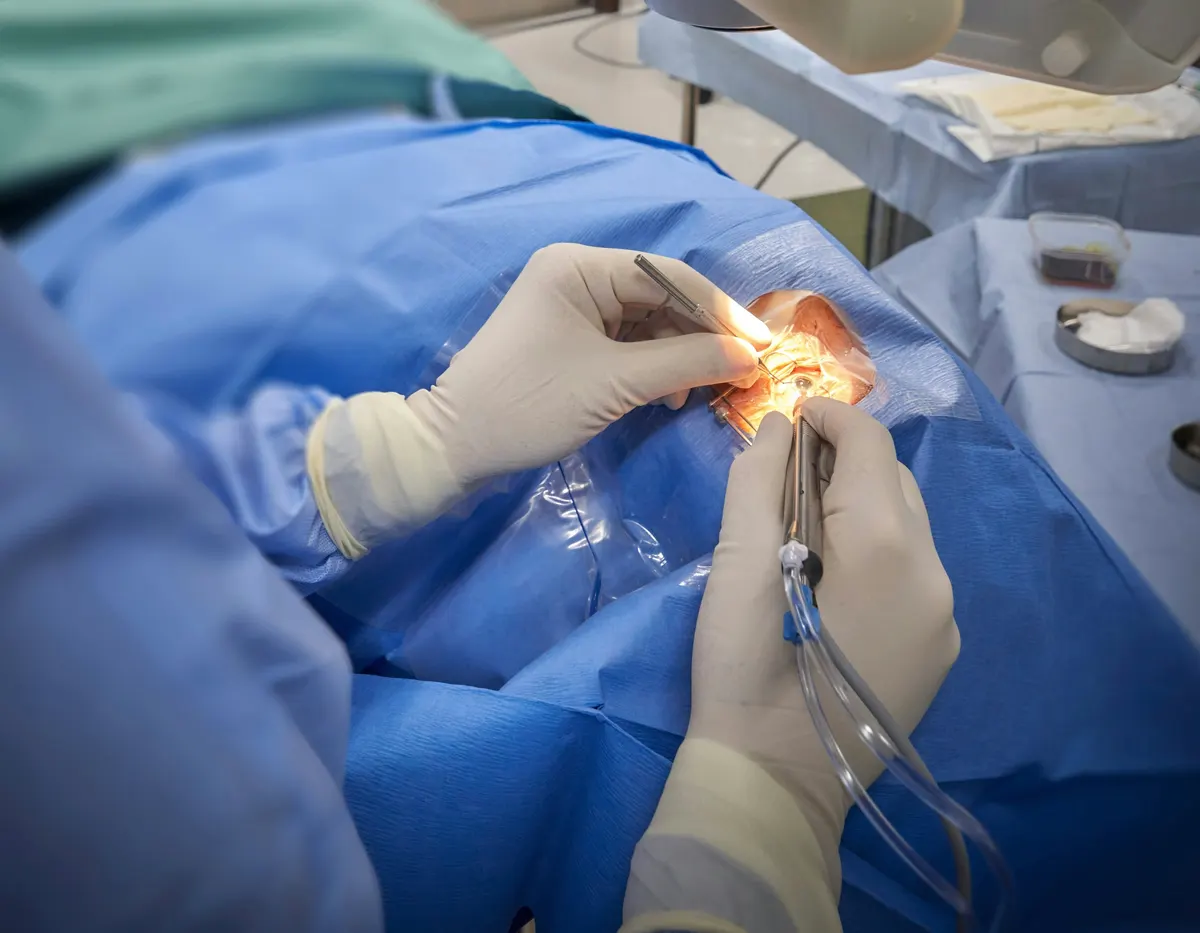
Cataract surgery
A cataract is the progressive clouding of the crystalline lens, the eye’s natural lens. With age it loses its transparency, making vision increasingly blurred, as though looking through a misted window. It is a natural part of ocular ageing, but it can also occur at a young age or secondary to certain eye conditions.
What are the signs?
A cataract develops slowly, often over several years. The most common signs are:
- Vision that becomes clouded or blurred
- Increased sensitivity to light and glare
- Colours that appear duller
- Growing difficulty with reading or night driving
- Frequent changes of spectacle prescription
How does the surgery work?
The procedure involves removing the clouded lens and replacing it with an artificial implant. It is performed in an operating theatre, as a day case, usually under local anaesthesia. The patient returns home the same day.
Key points after surgery
- Apply eye drops as prescribed (anti-inflammatory, antibiotic)
- Avoid rubbing the eye
- Protect the eye (protective shield at night) for the period indicated
- Avoid tap water in the eye for 1 week, and swimming pools and saunas for a few weeks
Implants at a glance
The choice of implant depends on your ocular anatomy, your daily habits and your visual expectations. It is discussed together during the pre-operative assessment.
Monofocal implant
Corrects vision at a single distance, most often for distance vision. Glasses remain necessary for reading or near activities. It is the reference implant, offering excellent visual quality with minimal visual disturbance (halos, glare).
Toric implant
Designed to correct astigmatism in addition to the cataract. Indicated in patients with a regular cornea, it provides sharper distance vision without depending on an additional correction for the astigmatism.
Multifocal / trifocal implant
Corrects several viewing distances (distance, intermediate, near) and greatly reduces day-to-day dependence on glasses. It is aimed at patients motivated by maximum visual independence, with a compatible ocular profile (regular cornea, absence of certain eye conditions). A neurosensory adaptation period of a few weeks is usual.
EDOF implant (extended depth of focus)
Offers continuous vision from distance through to intermediate, with fewer halos and less glare than multifocal implants. It suits patients seeking independence from glasses for intermediate-vision activities. Vision at less than 60 cm requires glasses.
The implant best suited to your situation will be determined during your consultation.